Are Dry Bags Fully Waterproof?
Are Dry Bags Fully Waterproof? What the Ratings Really Mean
Here's a question every dry bag owner asks eventually, usually while watching their bag bob in a river: is this thing actually waterproof, or just optimistic? The honest answer is that "waterproof" covers a huge range, from shrugging off drizzle to surviving a sinking, and knowing where your bag sits on that scale is the difference between damp disappointment and dry socks.
Waterproof vs water resistant: the real difference
Water resistant means water has to work to get in: rain rolls off, splashes bead up, but pressure or time will win. Waterproof means the material and the seams block water outright, and the only weak point left is the opening. Nearly all proper dry bags use genuinely waterproof fabric; where they differ is construction and closure, which is where the marketing and the physics sometimes part company.

The IP ratings, decoded in one paragraph
You'll see IPX ratings borrowed from the electronics world on some outdoor kit. The short version: IPX4 handles splashes and rain, IPX6 handles powerful jets, and IPX7 means survival when fully immersed at up to a metre deep for 30 minutes [1]. IPX8 goes deeper or longer, on the manufacturer's own terms. Two honest caveats. First, most dry bags aren't formally IP certified at all, because the standard was written for sealed electronics rather than bags with a hole you roll shut. Second, a high rating in one test doesn't automatically cover others: brief immersion and pressurised jets are different challenges [1]. So treat ratings as a helpful language, not a guarantee.
The other number on the label: what 500D actually means
Alongside IP ratings you'll often see a D number, like 210D or 500D. This is the fabric's denier rating, and here's the surprise: it has nothing to do with waterproofing. Denier measures the thickness of the yarn the fabric is woven from (technically, the weight in grams of nine kilometres of that yarn), so a higher number means thicker threads and a tougher, more abrasion resistant fabric. The waterproofing itself comes from the coating or lamination bonded to that fabric, not the weave.

So why does denier matter? Because in the real world, dry bags fail from wear before they fail from water. A bag gets dragged over rocks, wedged under kayak bungees, sat on, and sandblasted on beaches, and every scuff is testing the coating that keeps the water out. Thicker fabric protects that coating for longer.
| Denier | What it feels like | Best for | The trade off |
|---|---|---|---|
| Under 100D | Thin and crinkly, packs to nothing | Ultralight hiking, liner bags inside a rucksack | Precious; one sharp rock can end it |
| 200 to 300D | Light but reassuring | Casual paddling, festivals, gentle beach days | Fine until it meets shingle regularly |
| 500D | Thick, stiff, sits up on its own | Hard daily use: beaches, boats, being stood on | A little heavier and bulkier packed |
| 1000D | Truck tarpaulin territory | Expedition rafting, commercial use | Heavy and overkill for most people |
Our Waterproof Beach Dry Bag & Changing Mat, is heavy duty kit built to be thrown on shingle, stood on and generally treated without ceremony, which matters rather a lot for a bag that's also the mat you change on. 1000D is truck tarpaulin grade, bombproof but heavy, and honestly more than most people ever need to carry.
The takeaway: read the two numbers as a pair. The construction and closure decide whether water gets in today; the denier decides how many seasons of abuse the bag survives before anything changes.
What actually makes a dry bag dry
Welded seams beat stitched ones. Every stitch is a needle hole. Quality dry bags, including our Waterproof Beach Dry Bag & Changing Mat, use high frequency welded seams that fuse the material into one continuous barrier, which is why they stay watertight for years while stitched and taped bags slowly give up at the corners.
The roll top is the rating. A roll top with three or more tight folds traps a bend that water can't climb through, and the air sealed inside adds buoyancy, which is why a well closed dry bag floats rather than sinks. Fewer than three folds, an overstuffed bag (see our sizing guide), or a stray towel corner poking through the roll, and all bets are off.
Sand and salt are the slow killers. Grit in the roll creates tiny channels for water, salt stiffens fabric and buckles over time, and UV does the rest. A freshwater rinse after salty days takes seconds and adds years; it can share the rinse water you're already carrying for wetsuits and the rest of your kit.
The honest capability ladder
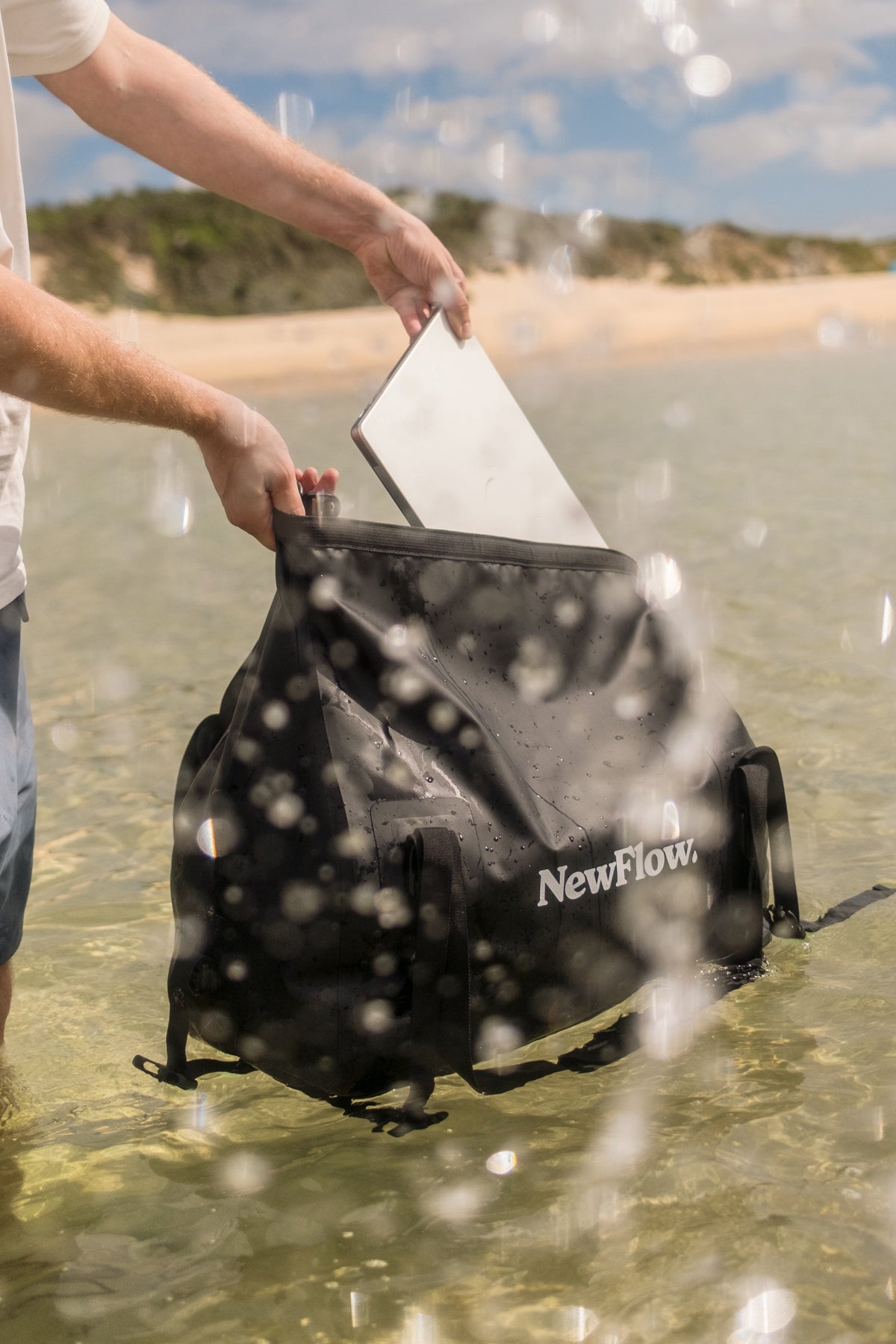
Rain, spray and splashes: any decent dry bag, all day long. A dunk or a capsize: a welded roll top closed properly will pass with flying colours. Floating on the surface for a while: fine, and the trapped air keeps it visible and retrievable. Sustained or deep submersion: this is where roll tops honestly tap out, and anything irreplaceable wants a purpose made sealed case. Which leads to the golden rule for phones: pouch inside bag. A small sealed phone pouch inside a big roll top gives you two independent barriers, and the big bag can then be opened casually on a wet deck or beach without risking the one item that really can't swim.
The two minute home test
Want to know exactly what your bag can do? Pack it with dry newspaper, close it properly, and hold it underwater in the bath for a minute. Dry paper: trust it with a capsize. Damp corners: it's a splash and rain bag, and now you know before the river tells you. Do the test once a season, especially for bags that live on boats in the sun.
A good dry bag, closed well and rinsed occasionally, is one of the most reliable pieces of kit you'll ever own. Just remember it's a system: fabric, seams and that all important roll, and you're the last seal in the chain. For what happens when the water wins anyway and everything's soaked, see what to do with wet kit after a swim.
References
- Trusted Reviews, What Is IPX7? The Water Resistance Rating Explained: https://www.trustedreviews.com/explainer/what-is-ipx7-4253505